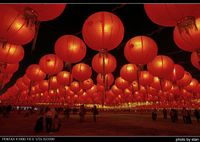
The streets were quiet this morning and many shops were closed. Tomorrow, it will probably seem like a ghost town in Taipei--well, that might be a slight exaggeration! Anyway, tonight, the kids were playing in the parks and the BBQs were roaring.
From what I've learned about Taiwan, I know that if a holiday lands on a Tuesday or Thursday, you also get the Monday or Friday off! Pretty cool--however, since it's really only a 1-day holiday, you have to make up the day off on a Saturday--YUCK! (Oh wait, it's not bad--just different!) Morrison, however, is not taking any days off. We have to balance the American and Chinese holidays, so we get American Thanksgiving off instead! Taiwan is preparing for a major Chinese festival! The Moon Festival takes place on the 15th day of the 8th month in the lunar calendar (which happens to be Tuesday, Sept. 25th this year). According to my awesome new children's book--
Moonbeams, Dumplings & Dragon Boats by Simonds and Swartz-- (which has the perfect level of information for a festival novice like myself) "Almost all major Chinese festivals follow a lunar calendar. The cycle of the moon is just less than thirty days, and twelve moons define the twelve months of the year. This year is shorter than the earth's 365 1/4 day trip around the sun; so, in order to keep the lunar calendar linked to the seasons, the
Chinese lunar calendar includes an extra month seven times every nineteen years. This is called an intercalary month."
Perhaps you've heard of the Chinese philosophy of Yin and Yang--

well, I learned that the Mid-Autumn Festival provides the legend behind this philosophy (or at least one explanation). Now, as with all my postings about Chinese culture, believe me--I am NO EXPERT! If I am getting some details wrong, or if you have more to add, please let me know, and I'll make the changes/additions ASAP! From what I've seen, the stories all vary slightly, but here's one I found that summed up most of them:
The Legend of the Moon Festival by Thomas W. Chinn, Historian
Originally named the Mid-Autumn Festival, the Moon Festival is one of the most important holidays celebrated by Chinese communities around the world.
Traditionally, it is celebrated on the fifteenth day of the eighth lunar month in observance of the bountiful Autumn harvest. Although old rituals are no longer followed, families continue to gather for a day to relax and eat moon cakes. Upon this occasion, the legend of the Moon Goddess, CHANG-O, is often told to children.
Once upon a time there was a famous archer, Hou Yi, who with his arrows was able to slay mankind’s worst enemies, ferocious beasts that inhabited the earth. Yi was married to Chang-O, a beautiful but inquisitive woman who had been an attendant of the queen mother of the west before her marriage. Now at this time, there were 10 suns that took turns circling the earth-one every 10 days. One day, all 10 of the orbs circled, together, causing the earth’s surface to burn and threatening mankind. The wise emperor of China summoned Yi and commanded him to kill but one of the suns. This Yi proceeded to do. Upon the completion of his task, Yi was rewarded with a pill, the elixir of life, and advised: "make no haste to swallow this pill, but first prepare yourself with prayer and fasting for a year." Being a wise man, Yi took the pill home and hid it under a rafter while he began healing his spirit, In the midst of this, Yi was summoned again by the emperor.
While her husband was gone, Chang-O noticed a beam of white light beckoning from the rafter. She followed it and a fragrant perfume, discovered the pill and swallowed it. Immediately, Chang-O found she could fly. Just at that moment her husband returned home, realize what had happened and began to reprimand his wife. Chang-O flew out the window into the sky. Yi sped after her, bow in hand, and the pursuit continued halfway across the heavens. Finally, Yi had to return to the earth because of the force of the wind.
His wife reached the moon and there, breathless, she coughed and part of the pill fell from her mouth. Now, the hare was already on the moon and Chang-O commanded the animal to take pestle and mortar and pound another pill so that she return to earth and her husband. The hare is still pounding. As for Yi, he built himself a palace in the sun as Yang (the sun and the male principle), Chang-O as Yin (the moon and the female principle).
Once a year, on the 15th day of the full moon, Yi visits his wife. That is why the moon is full and beautiful on that night.Since the round moon stands for "family," many reunions and BBQs are held during the festival. Round fruits like pomelos (Chinese grapefruit), apples, grapes, and melons are eaten and tea is served with a variety of
mooncakes. Some moon cakes are pretty good and filled with fruits or creams. Others aren't so tasty and are filled with noodles, meats, and other rather interesting tidbits. I've received a box of really yummy moon cakes filled with pineapple and cranberries from a student. They were made in a Taipei bakery and are quite beautiful. Even Starbucks has their own mooncakes that are said to be yummy!
I've been told that many families attend puppet shows in outdoor theatres, where the story of Chang E and her husband, Hou Yi is told again. I may head over to Da'an Park tomorrow night and check out the amphitheatre to see what's going on. Of course, weather permitting, I'll definitely check out the moon and see what I can see! Instead of "the man in the moon," perhaps I'll see a jade rabbit! I'll keep you posted . . .
Psalm 19: 1-4a
The heavens proclaim the glory of God. The skies display his craftmanship. Day after day they continue to speak; night after night they make him known. They speak without a sound or word; their voice is never heard. Yet their message has gone throughout the earth, and their words to all the world.


 Posts
Posts